Every pro forma I've ever seen has one thing in common: it looks fantastic. Steady rent growth, full occupancy, no surprises. That's not because the deal is actually that clean — it's because the spreadsheet was built to sell the deal, not underwrite it.
I'm not saying anyone's lying on purpose. Most of the time it's optimism, not deception. But the gap between what a pro forma assumes and what actually happens is where deals — and investors — get into trouble.
What the Spreadsheet Almost Always Assumes
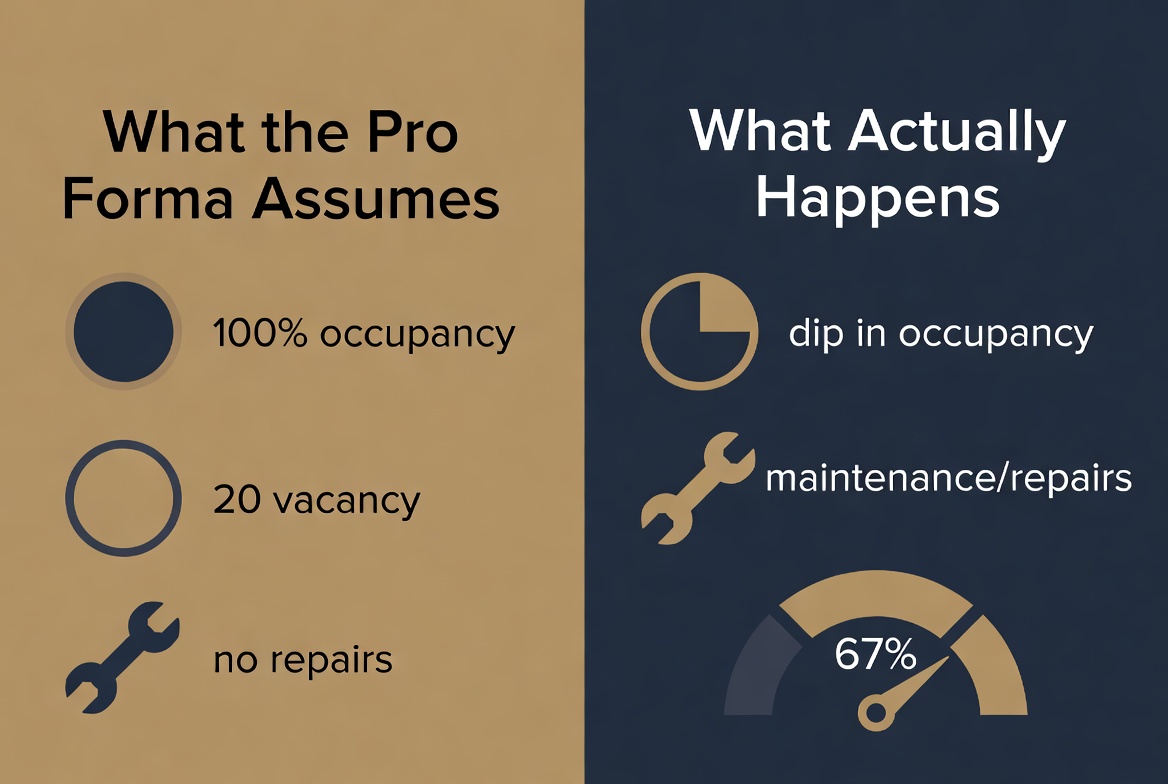
- 100% occupancy, or close to it — every unit rented, every month, with no lease-up period and no turnover gaps.
- Zero vacancy loss — even seasoned multi-unit operators budget for some vacancy. Pro formas frequently don't.
- No repairs, no surprises — no roof, no furnace, no burst pipe, no tenant who trashes a unit on the way out.
- Rent growth that never slows — projected increases that assume the market keeps climbing in a straight line.
A pro forma tells you what a property could earn under perfect conditions. A lender wants to know what it will earn under real ones. Those are two different numbers, and only one of them gets you funded.
Why This Matters More Than Most Investors Realize
When you present a deal to a lender, they're not underwriting your optimism — they're underwriting realistic income. Most lenders apply their own vacancy assumption (often 3-5% minimum, sometimes higher depending on property type and market) regardless of what your spreadsheet says. If your numbers only work at 100% occupancy, the lender's number is going to come in lower than yours, and your actual borrowing capacity follows it down.
A Realistic Adjustment — Multi-Unit Example
| Pro forma annual gross rent | $180,000 |
| Pro forma assumption | 100% occupied |
| Realistic vacancy allowance (5%) | -$9,000 |
| Realistic annual maintenance/repair reserve (est.) | -$7,200 |
| Adjusted realistic NOI input | $163,800 |
That's not a worst-case scenario. That's just a normal, defensible operating year — and it's already nearly $16,000 lower than what the pro forma projected. If your financing was sized against the optimistic number, that gap becomes a real problem the moment the market has an ordinary bad month.
What to Do Instead
- Build two numbers, not one — the pro forma for your own upside case, and a realistic underwriting case with vacancy and repair reserves built in from the start.
- Ask what vacancy rate the lender will actually use — don't wait to find out during underwriting. Different lenders and property types carry different standard assumptions.
- Budget a real maintenance reserve, not a token line item. Older buildings and larger unit counts need this more, not less.
- Present the realistic number to lenders up front — it builds credibility, and it means fewer surprises mid-file when the actual sizing comes back different from what you expected.
None of this means the deal is bad. It means the number on the spreadsheet was never the real ceiling — the realistic one was. Knowing that before you make an offer is the difference between sizing a deal properly and scrambling to make it work after the fact.