
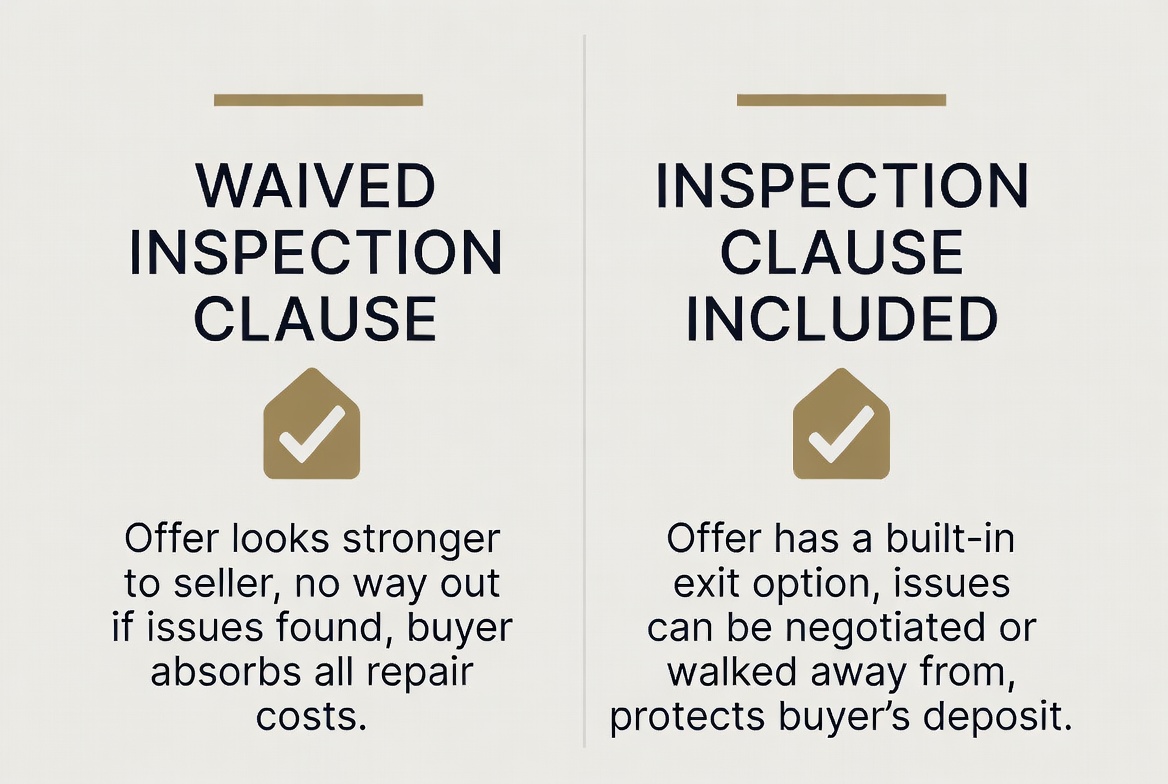
In a competitive market, waiving the inspection clause can make an offer look stronger to a seller — no conditions, no delays, nothing standing in the way of closing. It can also mean absorbing whatever's wrong with the house entirely on your own, with no way back out.
What the clause actually does
An inspection clause gives you a defined window, after your offer is accepted, to have a licensed inspector go through the property. If something serious turns up — foundation issues, knob-and-tube wiring, a failing roof — the clause gives you the right to negotiate a price reduction, ask the seller to fix it, or walk away from the deal entirely with your deposit protected.
Waive it, and none of that exists. You're committed the moment your offer is accepted, sight unseen on anything beyond what you could tell by walking through it yourself.
A waived inspection clause doesn't make the problems in a house disappear. It just decides, in advance, that they're entirely your problem to solve.
Why buyers do it anyway
In a hot market with multiple competing offers, a clean offer with no conditions genuinely does look more attractive to a seller than one with an inspection contingency attached. Buyers waive it because they believe it's the difference between winning the house and losing it to someone else.
Sometimes that's true. But it's a real trade, not a free move — you're giving something up to make your offer more competitive, and it's worth being honest with yourself about what that something actually is.
What it can actually cost you
Foundation repairs, knob-and-tube rewiring, oil tank remediation, roof replacement — these aren't small numbers, and they don't show up on a walkthrough. Buyers who waive the clause and then discover a serious issue after closing have no recourse; the cost lands entirely on them, often within the first year of ownership.
Is there a middle ground?
Sometimes. A pre-offer inspection — done before you submit, on your own schedule, outside the pressure of a bidding war — can let you make an informed decision about whether to waive the clause on that specific property, rather than waiving it blind on every offer as a blanket strategy.
Bottom line
Waiving the clause can be the right call in the right circumstances — but it should be a deliberate decision about a specific property, not a reflexive move to look competitive. Know what you're actually giving up before you give it up.
Don't waive your protection to win a bidding war. Call 902-465-5533 — I answer.
Patrick Sawler
Principal Broker, Craigburn Capital
I look forward to hearing from you in regard to your mortgage needs.
902-465-5533. I answer.
Patrick
p.s— You can click on this link to start the process whenever you are ready. Schedule your meeting with me here.
p.s.s— I should tell you that I am licensed in Nova Scotia Brokerage (2025-3000179) Broker (2025-3000180), Ontario (M23006699).
p.s.s.s— You can download my new mortgage app here
Patrick Sawler is a mortgage broker and owner of Craigburn Capital, licensed in Nova Scotia and Ontario, with private financing available in New Brunswick and PEI. He answers his phone.
Ready to have a real conversation? Call 902-465-5533 or start your application here.